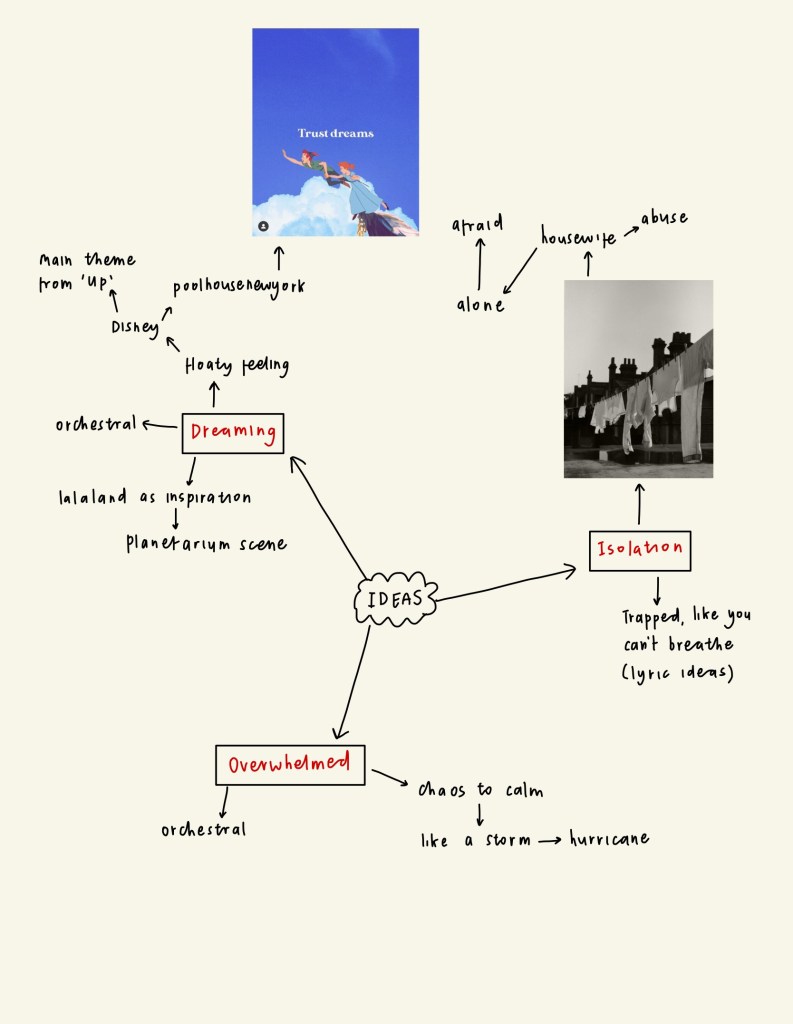
To begin this project, I created a mind map of ideas that I had. These ideas came from words which could tell a story in some way. I knew I wanted to centre my piece around the flute, so they had to be themes in which a flute would be applicable. Because I want to tell a story, and use predominantly classical instruments, the genre which resonates the most with me is instrumental film music or classical music. These genres make the most sense to me, as it will allow me to use my flute in an expressive way, to create the emotions the theme requires. Not only this, it will allow me to experiment with different ways of recording for example: recording in a hallway; or placing he microphone behind me whilst I play.
After looking at several examples of music, and examining the themes I have written out, I have decided that I will focus on the theme of dreaming, and see where that leads me.
The musical LaLaLand is a great source of inspiration for me, specifically the planetarium scene. The instrumentation used in this piece is perfect for the story which is being told throughout this scene. They are in a dream like state, which correlates to my initial idea. Flute and piccolo are prevalent instruments throughout, so it is useful for picking up on ideas to create a dreamy feel. An example is the trills that are used in the high register which create a sense of fantasy and escapism.
Another piece that caught my attention was the theme song ‘Married Life’ from Up. I think this piece is composed in a particularly clever way. Initially, the mood set is a joyful one. It reminds me of a how a child’s dream may be presented; full of life and wonder. This is presented through a very basic motif, giving the piece an upbeat and excited atmosphere. At 1.13, there is a significant change in mood. The motif remains the same however we are suddenly enraptured by a sudden atmosphere change. It becomes sad, which is evident by the change in tempo. This gave me chance to think about what kind of story and atmosphere I wanted to create. As well as this, I was able to see how a small idea can be manipulated to create a huge effect. The story is effortlessly told through this piece, and with very few melodic ideas.
Film scores are incredibly effective in creating emotion for the audience. Even without the scene, the music still conveys the feeling that would be being portrayed within this scene. The contrast between the low strings and high notes on the piano create a beautiful effect. There is also a lot of rise and fall to be heard, with lots of peaks in the strings which gives me the image of being high in the clouds, floating. Again, a repeated melody on the strings is used, and it creates a huge effect when it is used in the same way, just in a different key. The effect a change so small can have allows me to think about ways in which I can create a flute melody, and use it to create the impact and feeling of dreaming I intend to do.
One common feature I have noticed in all three of these pieces, is their use of strings and the time signature used for them. Each of them are in either a 3/4 or 6/8 metre. Often the strings will land on each quaver within the bar. This is particularly noticeable in the Theory of Everything soundtrack. As all these pieces reflect a dream like feel for me, I will keep these points in mind when I create my composition, as it is a frequent occurrence in this type of music. As well as the time signature, the instrumentation used in these pieces is very similar, with pizzicato strings and high register instruments (flute, piccolo, top end of the piano) being used frequently. This instrumentation creates a dream like feel for me, so is something I will include within my own composition.
 Megan Phillips Music Technology